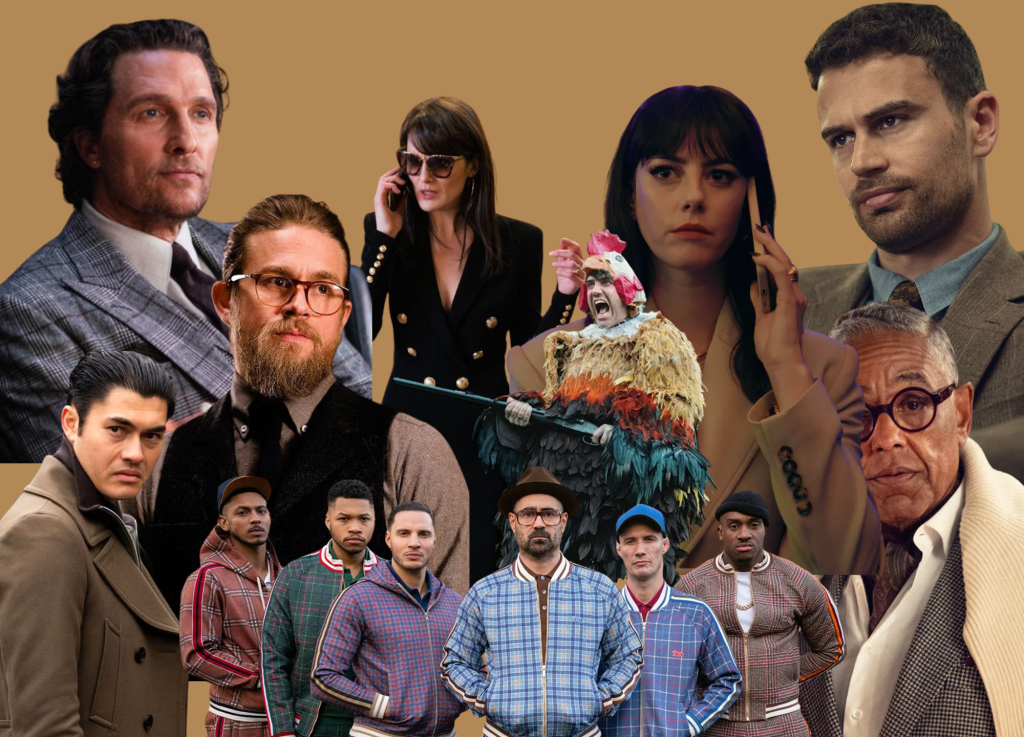
The Gentlemen (film) has been my go-to comfort movie when I want a bit of laughter, a lot of sexy gangsters running around London getting revenge, and the inner workings of a marijuana crime syndicate. Guy Richie, English film director, screenwriter, and creator of The Gentleman brings in a concoction of men, guns, and fighting for an explosive yet occasionally naughty performance.
But color me surprised when looking up the title on Netflix and I come across eight episodes of a show with the same title but a completely different cast.
The 2019 film stars Matthew McConaughey as Michael ‘Mickey Pearson, Charlie Hunnam as Raymond Smith, Henry Golding as ‘Dry Eye’, Michelle Dockery as Rosalind Pearson, Eddie Marsan as, Colin Farell as Coach, and Hugh Grant as Fletcher. The movie follows Mickey Pearson, an American cannabis wholesaler with one of the most prolific drug empires in England. When he looks to sell the business, it sets in motion a chain of blackmail and schemes to undermine him and his power.
In comparison, The Gentlemen is a 2024 TV show of the same world, also written by Guy Richie, with the same premise but focused on the workings of one of the locations of the cannabis farms. It stars Theo James as Edward “Eddie” Horniman, the 13th Duke of Halstead, Kaya Scodelario as Susan “Susie” Glass, Daniel Ings as Lord Frederick “Freddy” Horniman, Eddie’s older brother, Ray Winstone as Robert “Bobby” Glass, Susie’s father, and Giancarlo Esposito as Stanley Johnston.
Our introduction to this world is the film, which gives us an explanation of the magnificent setup of the business, how secure and airtight it is from outside threats, a model, and how the machine works, then we get a deep dive into the everyday happenings of the business on one site. In the film, though they get down and dirty here and there, they bounce right back with the ego and haughtiness of a room full of men.
The Gentlemen (film)
The delivery and tone are the same as in the film. The high society regality remains the same at a smaller level.
The content is where it gets drastically different. The thrill of the film comes from the danger and silent threats, like the threat of a cold knife at your throat that will never cut you. But with the show, ridiculous scenes litter each episode, most memorably the chicken dance scene. The briefing was infuriating in how Edward delivered the instructions one-by-one to Freddie but the reasoning works considering his volatile nature. The performance is retribution at first but heartbreaking as it went on. As infuriating as Freddie is, you watch as his humanity is torn away with each yelled note of “BE A FUCKING CHICKEN.” And just as extreme is his reaction when he gets fed up and shoots him in the head with a shotgun. The second watch is almost as riveting as the first, with jokes and comments telling of what is about to come.
The film works by dipping its toes in the dirty work but never fully immersing itself in the muck. The show is more new school and bold with its options. They try to keep it clean, but as young as they are, a few killings happen as they try to keep their business running smoothly.
Plot
The premises are similar, following the workings of a marijuana wholesale business in England, and the business is put on the market at different points. Where they defer is in the details; where Mickey Pearson, the kingpin, is looking to sell his business and retire, we see the battle for the business as what follows. But in the show, the kingpin isn’t revealed until later and takes on a smaller role as a recurring character, and rather our focus is on the new Duke of one of the farms right upon his father’s passing and he inherits the title. We get dirt and grime, the dirty work Pearson would order is enacted in the show.
The Gentlemen (TV show)
There is heavy emphasis placed on the style, emulating an old school type of gangster, with honor and a certain respect for certain happenings (very cinema porn kind) with Fletcher threatening to uncover their entire operation and blackmails Raymond with a screenplay and record of their accounts to sell to the highest bidder along. As a result, he conveniently acts as a narrator for a nonlinear timeline of events he tells to Raymond, with filthy, crude, and on-the-nose offensive humor.
From a certain angle, you could consider the film as the world of the big boss executives and the show’s stakes are not as grand and inserts of jokes that the lower management can relate to (if you put aside the crime and cannabis syndicate).
It was infuriating to watch Freddie make mistake after mistake even when the ongoing was happening because of his previous mistakes. At times I wished he would get what comes to him but then his humanity is stripped away and nothing good ever comes from his actions, even those well-intentioned, you just can’t help but want him to get one win.
Cast
Raymond Smith vs Edward “Eddie” Horniman
Raymond Smith is Mickey Pearson’s OCD right-hand man who carries us both in the narration of the story as well as the audience for Fletcher’s blackmail plot. When Fletcher comes to blackmail him and the business, which in association is Mickey, Raymond tries to navigate the delicate situation without him knowing. He is focused, intelligent, and strategic, efficiently moving, and always putting considerable thought into every action. Cool, calm, and collected, he is almost always serious and all business, rarely losing his composure and a sharp tongue with even sharper wordplay. Hardened by years of being in the business, he is the perfect right-hand man with unyielding loyalty to Mickey Pearson.
Edward Horniman is an army officer who returns to England while his father, Duke of Halstead, is on his deathbed and upon his passing, inherits the title and becomes the new Duke of Halstead. He is a headstrong man, with a straight-arrow focus and discipline who does everything for his family and finds a way to wash their hands of the Glass family. In a sense, he is a sort of second in command, and his auctions and resolve evolve to be nearly on par with Raymond Smith’s role in the film.
Michael “Mickey” Pearson vs Robert “Bobby” Glass
Mickey Pearson is our film protagonist and a man to be reckoned with. A powerful drug lord with one of the biggest cannabis empires in the UK he operates on the belief that “If you wish to be the king of the jungle, it’s not enough to act like a king. You must be the king and there can be no doubt. Because doubt causes chaos and one’s demise”. Cool, poised, and charming, he is skilled in speaking and outwitting others and understands that in this line of business, vulnerability is not an option and he has to be resolute in embodying confidence and authority. His one soft spot is his wife, Rosiland, who is part of the reason why he wants to retire, to spend more time with her and raise a family.
In comparison, Bobby Glass is just as well respected, even by is competitor, but his history is not revealed. But he is incarcerated and his movements are limited to a luxury open prison. We fall back to him when things go awry and when matters regarding the business as a whole are involved. He is always in the know about what is happening on the outside, admonishing his daughter Sussie for going overboard in her pursuit of revenge, but we never get time to explore him fully as a character and he is in a more advisory role.
“Dry Eye” vs “Freddy Horniman”
Dry Eye is cunning, debonair, and direct but smart in his movements, for the most part. He is after Mickey’s business and with an unreliable narrator like Fletcher, we have to trust that his depiction is accurate save for the moments Raymond protests the image Fletcher paints of him. The right-hand man of Lord George, a Chinese cocaine druglord, is a lot rougher in his ruthless approach to acquiring Mickey’s business. His loyalty is questionable and is a headstrong character who is not suitable for taking orders.
Freddie is a cocaine addict (how ironic), who is mainly a problem for his family, prideful and not willing to submit even when he has majorly fucked up. His ego creates problems for his family more often than not, a majority of their enemies are as a result of his actions. He, in my opinion, makes an almost well-rounded growth in the timeline of the show. He finds a way to focus his energy on creating a new product for the business and is the only one actively opposed to getting rid of the Glass family. His greed still knows no end and his loyalty is questionable but he is a relief to have around. Somebody has to do the ugly work once in a while, but controlling him becomes a task in itself.
They are similar in how insane the lengths they are willing to go to get what they want.
Rosalind Pearson vs Susan “Susie” Glass
Rosiland is Mickey Pearson’s wife, a successful businesswoman in her own right, running a luxury garage run almost entirely by women staff. Never breaking face even on the verge of death, she is a strong woman who carries that strength into her relationship with Mickey. She has an addictive personality, sass rolling off her in abundance at the same time.
Susie Glass is what we wanted from Rosiland. More of her, more time to see her work, and girl boss to the max. She makes a point to keep her hands clean all the while managing the farm on Edward’s estate and 12 other farms elsewhere. Her loyalties lie with family, fiercely protective and willing to do anything to protect or avenge them. Calm and collected, she hardly loses her composure even when she is enraged for being ‘double crossed’, she moves forward with an icy heart and barely breaks a sweat.
Now, be it the higher echelons of society, which frankly feels more like a screenplay within a screenplay. Or the new Duke of Halstead, Edward Horniman, which brings the dealings of espionage to a more affordable level for the common folk, they both have a different flavor that may suit your palette.
Eight episodes, each an hour long seems daunting, especially since the film runs for one and a half hours. But before you know it, the birds are chirping outside your window and you’re grinning in satisfaction as the final credits roll.
In conclusion, which is better? Both have their charm, not particularly unique to one another yet unique in storyline. The show takes the film and expands on the details and moments you were left craving for in the first place. And it works. Addictive, charming, edge of your fucking seat anxiety, but that’s what makes it all the more fun.
 DARK GREY
Leave a comment